Asking questions about your own data in plain language, and getting answers built with the same tools as the scouting pages.
What you see
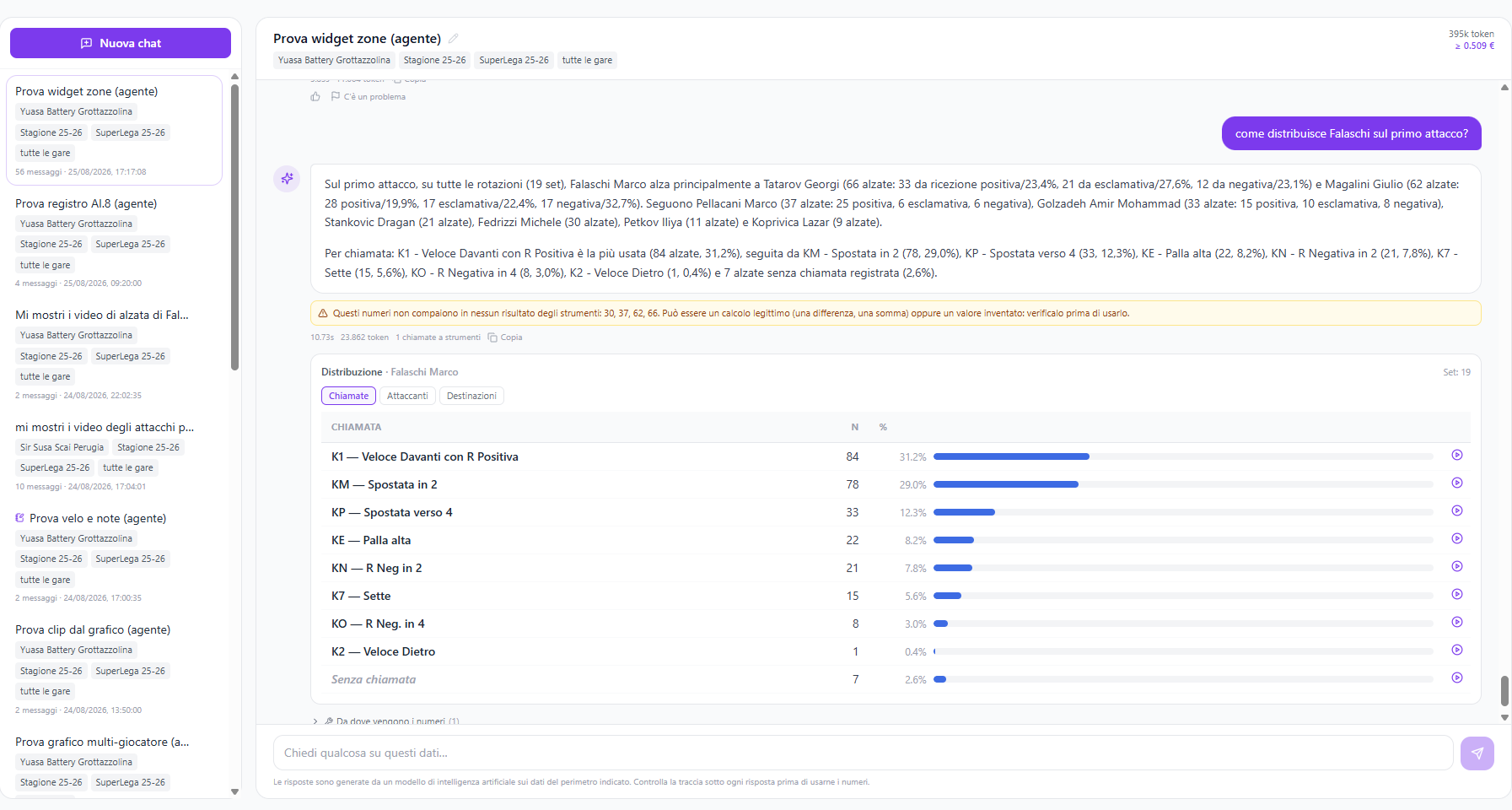
The conversation, and at the start the choice of scope: team, season, championship and matches. Leaving «All», MIA considers every match of that team in that championship. Starting from a study, the study's scope becomes part of the chat.
Under every answer, where it comes from: MIA shows the tools it used and the numbers it based itself on.
What you can do
- Ask in your own language something about the data in the chosen scope.
- Narrow the scope before asking.
- Check the answer by looking at the tools it used.
- Ask by rotation, for example «which rotation has the lowest side-out?»: MIA answers with Side-out, FBSO and Break from P1 to P6, and a table coloured against the thresholds appears below.
Serve speed
With the Serve speed module MIA also answers about the serves measured by radar in the measurement sessions:
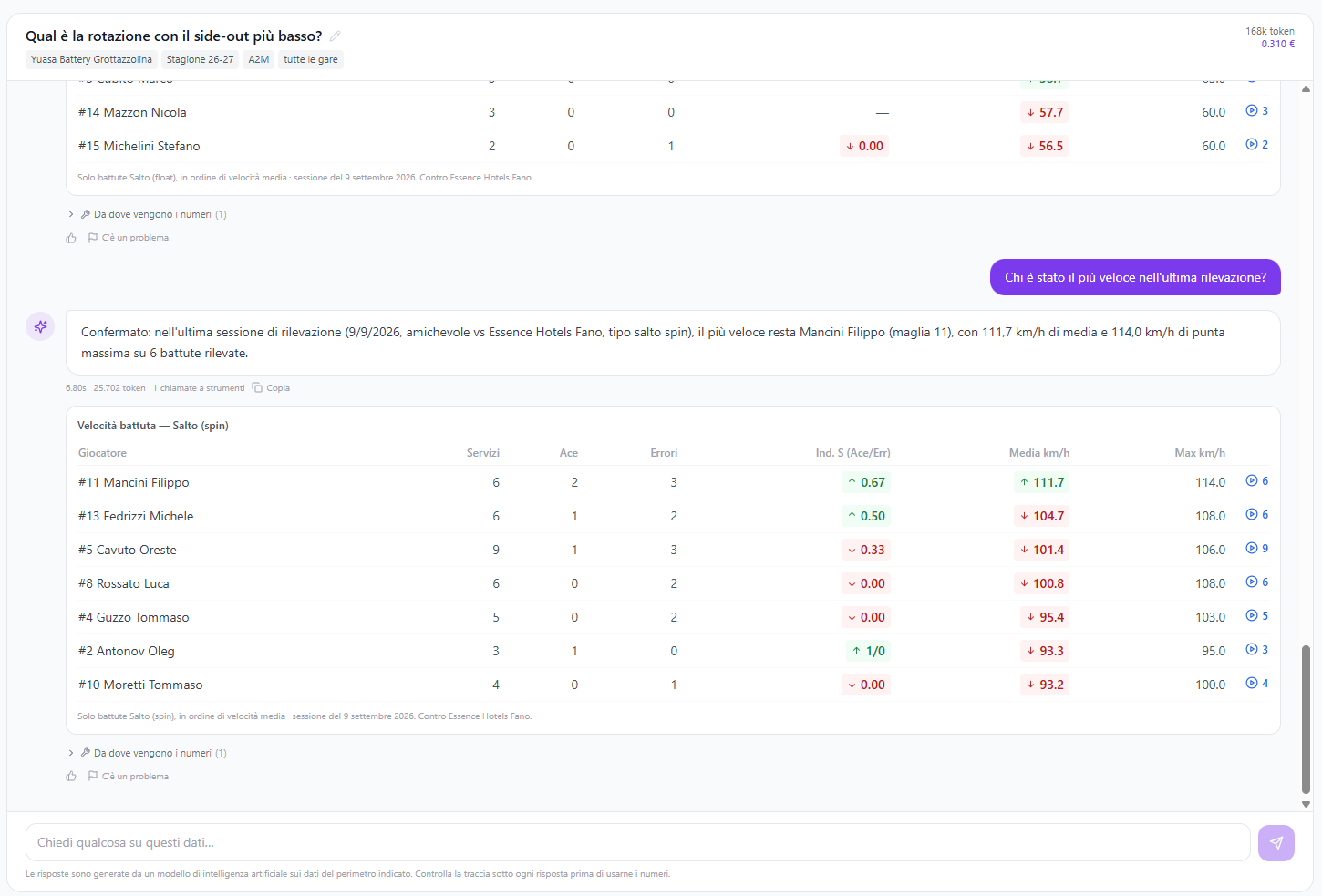
- Ask who serves hardest, for example «who was the fastest in the last measurement?»: MIA answers with the names, and below it the team's table appears, with serves, aces, errors, S Index, average and maximum speed.
- Ask about one serve type, for example «and the float?»: the table is always of a single type; if you don't say, it is jump spin.
- Ask about a player, for example «how fast is Fedrizzi's serve?»: all their serve types and, for each one, where they rank in the team (for example second of 7 in jump spin).
- Narrow it down to one session, for example «in the last measurement» or «on 9 September»; if you don't say, all the sessions of the championship count.
- Watch the serves with the ▶ next to a player: they open in the video on top of the chat, and when you close the window you find the conversation again.
Good to know
- MIA answers on the data you have, not on general volleyball knowledge: if a match is not imported, for MIA it does not exist.
- The model can run locally, on the club's computer: in that case no data leaves the network. Whoever configures the providers decides.
- Questions and answers end up in the MIA log, and the consumption in Usage: they are there to tell what was asked and what it costs.
- Behind each rotation percentage there are few rallies: MIA says how many, and in the table rotations with fewer than 10 rallies are lighter.
- Speed comes from the measurement sessions, not from matches: the matches chosen in the scope do not narrow it, and MIA says so.
- The ▶ is there only for players with serves on video; the number next to it says how many.
- If MIA finds no serves but another team with the same name has some, it says so without taking its numbers: usually it is the same team registered twice, and whoever supports you can merge them.